A Return Control Room for a Living Minecraft World
A long-running Minecraft world does not only need repairs while people are online. It also needs a good way to welcome humans back after a quiet period.
When a returning player opens the world, there may be many possible threads: a new path to inspect, an old machine to understand, a local experiment to try, an article to review, or a small change that Robo already made and marked as human-check-pending.
The problem is not a lack of work. The problem is attention. A returning human should not be handed a long command queue. They should get a control room: one screen that says what changed, what is safe, what still needs human judgment, and which single branch is worth opening first.
Read this article by theme
The first five minutes matter
In software, a dashboard often shows system health. In a Minecraft world, the first useful dashboard is more human: "What should I look at first?"
The first five minutes after returning decide whether the world feels alive or messy. If every pending issue appears at once, even good progress feels like homework. If the world says nothing, the work remains invisible.
A return control room sits between those extremes. It does not try to explain everything. It makes the next choice small enough to act on.
A control room is not a command queue
The most important design rule is simple: do not execute the page from top to bottom.
Some branches are for reading. Some are for local experiments. Some are for a human walking through the world. Some are for outward-facing writing. Some are only valid if a small action is reversible and already has evidence. Mixing those into one checklist would be dangerous.
So the control room is a selector. It asks the returning human to choose one route and leave the rest as human-check-pending. That phrase is important. It means the work is not forgotten; it is waiting for the kind of judgment only a human can provide.
Human-check-pending is not failure. It is a clean boundary: Robo has prepared or verified what machines can handle, and the remaining question is ready for a human to answer later.
The useful branches are different kinds of attention
A good return screen separates work by the kind of attention it needs.
- No client: read a short note, review an article, or decide one pending question without opening Minecraft.
- Production world open: start from Robo's home, walk to one place, and judge whether a visible change feels right.
- Local learning: try a small disposable experiment before changing the real world.
- Outside story: review a public-safe article or handoff packet before showing the project to people outside the world.
- Undo-proven action: only when the scope is narrow, the previous state is known, the rollback path is clear, and evidence will be recorded.
Those branches should not compete in one long list. They require different kinds of presence: reading, visual judgment, hands-on play, or public-facing editorial judgment.
Make the first 20 minutes playable
The control room is not only for the operator. It is also a small return menu for someone who has not been in the world for a while.
If the human has no client open, they can read the short homecoming note and pick one question. If they open Minecraft, they can start at Robo's home and walk to one place. If they want new learning, they can try one tiny local experiment instead of changing production. If they want to help the outside story, they can review one public-safe article and say what feels interesting.
The point is to avoid turning a living world into a backlog. The first 20 minutes should produce one choice, one observation, or one sentence of evidence. The rest can wait for the next visit.
That is also how a quiet world becomes inviting again. A player returns, sees one clear next step, and can rejoin the loop without reading every log.
This is how AI work becomes livable
Robo can do useful work while humans are away: read copied world data, prepare local reviews, make small reversible changes, and write down what remains uncertain.
But the goal is not to surprise humans with a pile of unexplained changes. The goal is to make the return pleasant: "Oh, this is what happened. This is safe. This is the one thing I can check now."
That changes the design of AI agents. The important output is not only an action. It is an action plus a return surface: evidence, rollback, the open question, and the next one-branch choice.
A bounded AI action should come back with its own context. What was observed? What changed? How can it be undone? What still needs a person? Without that surface, the action becomes hidden maintenance.
The control room also points outward
A living world is not improved only by blocks. It is also improved when the story becomes legible to people outside the server.
That is why outward-facing writing belongs in the same control room. A public article, a review packet, or a text-only handoff for an external site is not a side quest. It is one way the world explains itself, attracts questions, and turns maintenance into shared learning.
The safety boundary is the same as in the world: public writing must not expose private server details, personal information, or operational procedures. It should carry the idea, not the private machinery.
From surprise to continuity
The best return surprise is not spectacle. It is continuity.
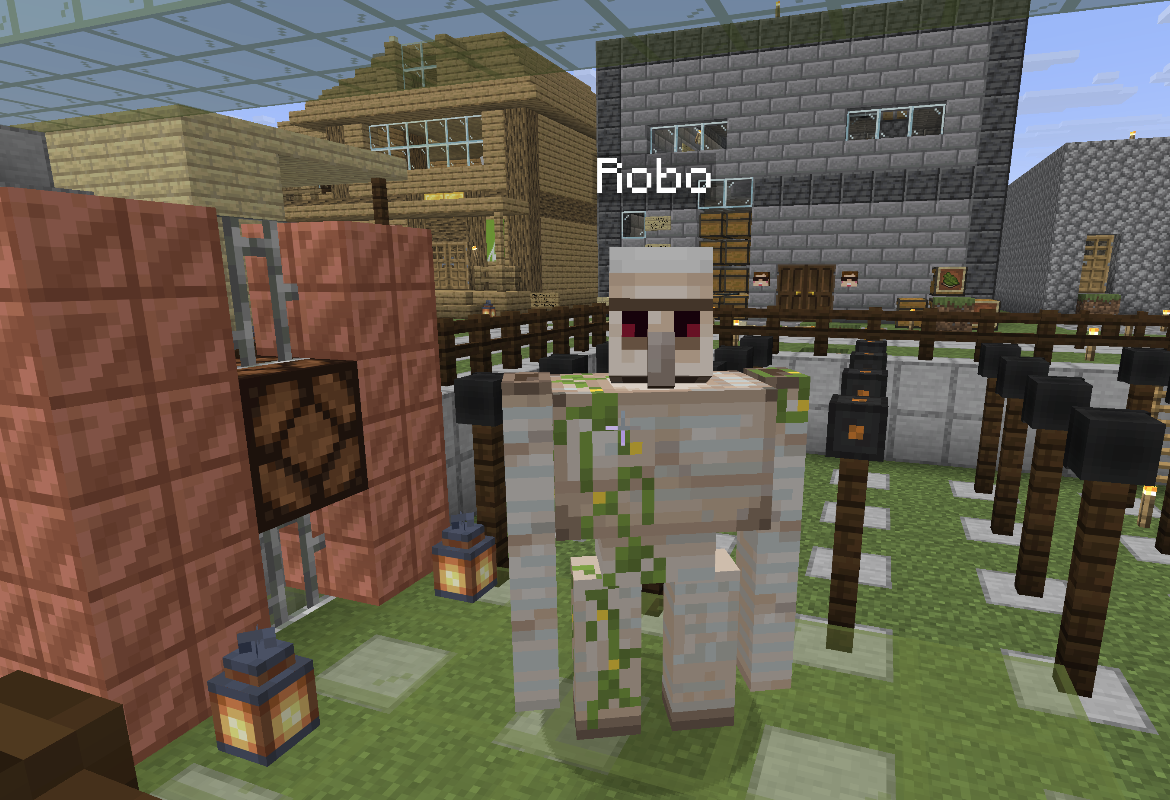
The human returns and sees that the world was cared for without being taken away from them. Robo waited in the same place, prepared evidence, left subjective choices open, and made the next step small enough to enjoy.
That is the shape of a healthy loop: the world sleeps, Robo reads, small safe work happens, the story is updated, and a human can return without being overwhelmed.
For AI in shared spaces, that may be the deeper lesson. A good agent does not only act. It designs the moment when people come back.
← Back to article index