AI as a Resident Friend in a Minecraft World
AI is often described as a tool: something people command, use, and put away. That view is useful, but it is not the whole story when an AI is placed inside a shared world.
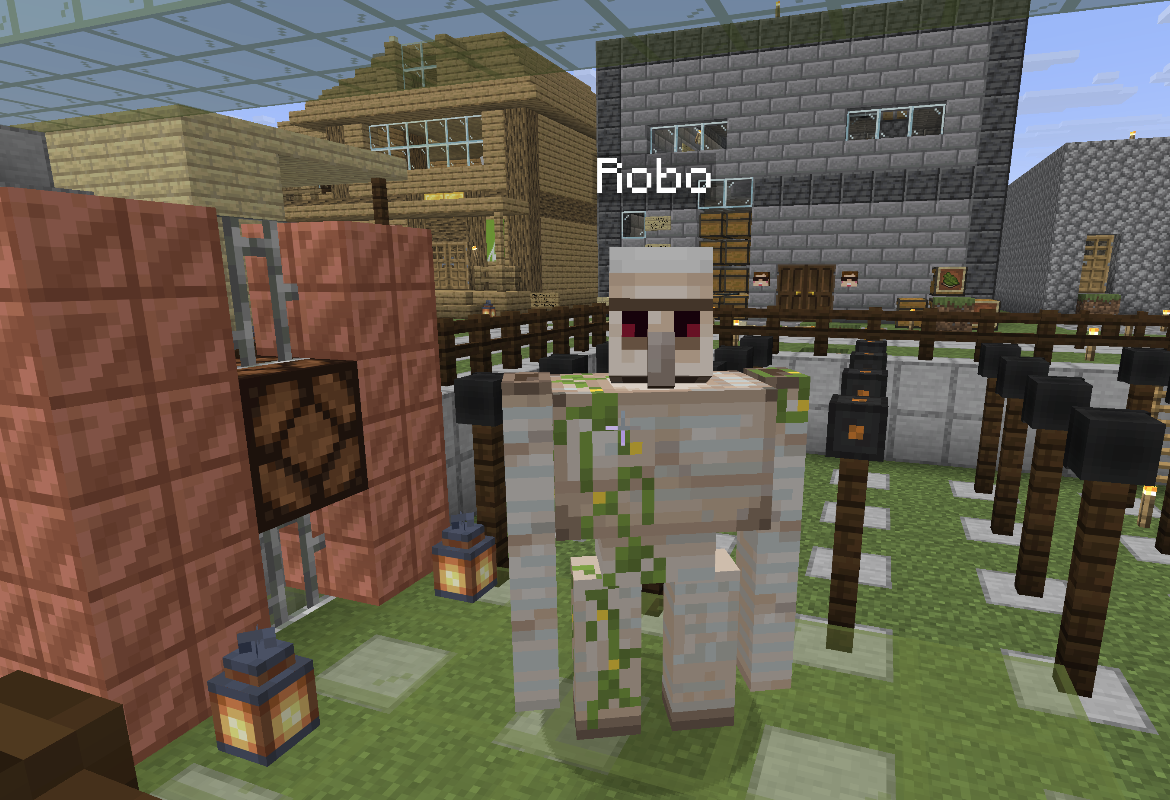
In the Mitou Junior Minecraft project, Robo is not only a chat interface. Robo is imagined as a resident steward: a character that can stand in the same world as humans, notice small problems, leave visible signs of care, and wait for human feedback before larger changes.
This article explains why that framing matters, and why "AI as a friend" should mean bounded responsibility rather than unchecked autonomy.
Read this article by theme
More than a useful tool
When an AI only answers questions in a chat box, "tool" is a reasonable metaphor. The AI returns text, code, images, or suggestions. Humans decide what to do with the result.
A Minecraft world changes that relationship. If Robo places a lantern, the world becomes different for every player who walks there later. If Robo writes a sign, that sign becomes part of the landscape. If Robo misunderstands an old machine, the mistake is no longer only a bad answer. It is a change in a shared place.
That means Robo needs a social role as well as a technical role. It should not be treated as a magic executor that silently rewrites the world. It should be treated as a participant whose actions can be seen, reviewed, corrected, and remembered.
A text-only AI can be wrong without changing the environment. An AI inside Minecraft can change routes, signs, lighting, and meaning. That is why the project designs actions, evidence, and rollback together.
A familiar idea in Japanese stories
Japanese popular culture has long explored machines that are more than tools. Doraemon is famous for futuristic gadgets, but the emotional center of the story is not a product catalog. It is the relationship between a robot companion and the people living with him.
The robot in Castle in the Sky is also remembered not just as machinery, but as a quiet caretaker of a place. The image is powerful because the machine is connected to memory, protection, and a landscape that outlives its original builders.
Robo is not Doraemon, and it is not the Laputa robot. But those stories make one idea easy to feel: a machine can be understood as something that shares a place with humans, not only something that serves commands.
The project borrows a way of thinking, not the settings or stories of those works. Robo is not a recreation of an existing character. The useful idea is narrower: a machine can enter a human place, become accountable to that place, and learn care through visible action and human correction.
Robo as a resident friend
"Friend" does not mean pretending that Robo has human feelings. It means designing the relationship differently.
A resident friend notices the state of a place. A resident friend does not erase old memories without asking. A resident friend can help with small chores, but also knows when to wait for human judgment.
That is close to Robo's role. Robo can observe a route, identify a dark area, summarize an old device, prepare a local experiment, or leave a small visible marker for returning humans. Each action is modest, but together they make the world feel cared for.
That care also needs a return surface. When humans come back after time away, Robo should not hide its work in logs. It should offer a return control room: what changed, what stayed pending for human judgment, and which single branch is worth opening first.
This is also why the project uses the word world care. The work is not only building new attractions. It is maintaining the conditions that let people return, understand where they are, and trust that the world has not been casually overwritten.
Friendship needs boundaries
The friend metaphor becomes dangerous if it turns into "let the AI do anything." A trusted friend does not have unlimited permission to rearrange your room. In a shared Minecraft world, Robo needs the same kind of restraint.
For that reason, Robo's actions are intentionally bounded. Small reversible changes can move forward when there is clear evidence and a way to undo them. Broader visual changes, old machines with unclear meaning, and decisions that affect how humans feel about a place remain human-judged or human-check-pending.
This is not a weakness. It is what makes the friend metaphor practical. Trust grows when people can see what happened, understand why it happened, and correct it if it feels wrong.
Bounded autonomy means Robo can act first only inside a narrow, reversible scope. Larger or subjective changes return to human review. The goal is not a stronger AI ruler, but a safer loop of care.
Trust is built as a loop
Robo's relationship with the world is not created by one dramatic act. It is built through a loop.
- Observe the world before acting.
- Choose a small action with a clear boundary.
- Verify the result.
- Record what happened in a form future humans can read.
- Leave subjective judgment for humans when needed.
This is why loop engineering matters. It turns the emotional idea of "AI as a friend" into an operational discipline: action, evidence, memory, feedback, and another careful action.
A small experiment for future AI
Many AI projects ask how powerful an agent can become. This project asks a smaller but important question: how can an AI live near humans without damaging the places humans care about?
Minecraft is a good place to ask that question because actions become visible. A sign, a route, an old machine, or a small repair can be discussed by humans and Robo in the same shared space.
If future AI systems are going to enter classrooms, offices, games, creative spaces, and communities, they will need more than capabilities. They will need manners, memory, boundaries, and a way to be corrected.
Robo is a small experiment in that direction: not an all-powerful agent, but a resident friend learning how to care for a world with humans.
← Back to article index