Digital Twins for a Minecraft World
In a shared Minecraft world, "let's try it" can be risky. A new path, a sign, a small repair, or an AI-made change may become part of the place before anyone has had time to judge it.
This project uses a simple idea: before changing the real world, test as much as possible in a copy. The copy is not just a backup. It is a working twin where Robo can fail cheaply, learn what is mechanical, and bring a smaller question back to humans.
Read this article by theme
A copy is not only for recovery
Backups are usually discussed as a way to recover after damage. That matters, but a copied world can do something earlier: it can let Robo test a change before the real world is touched.
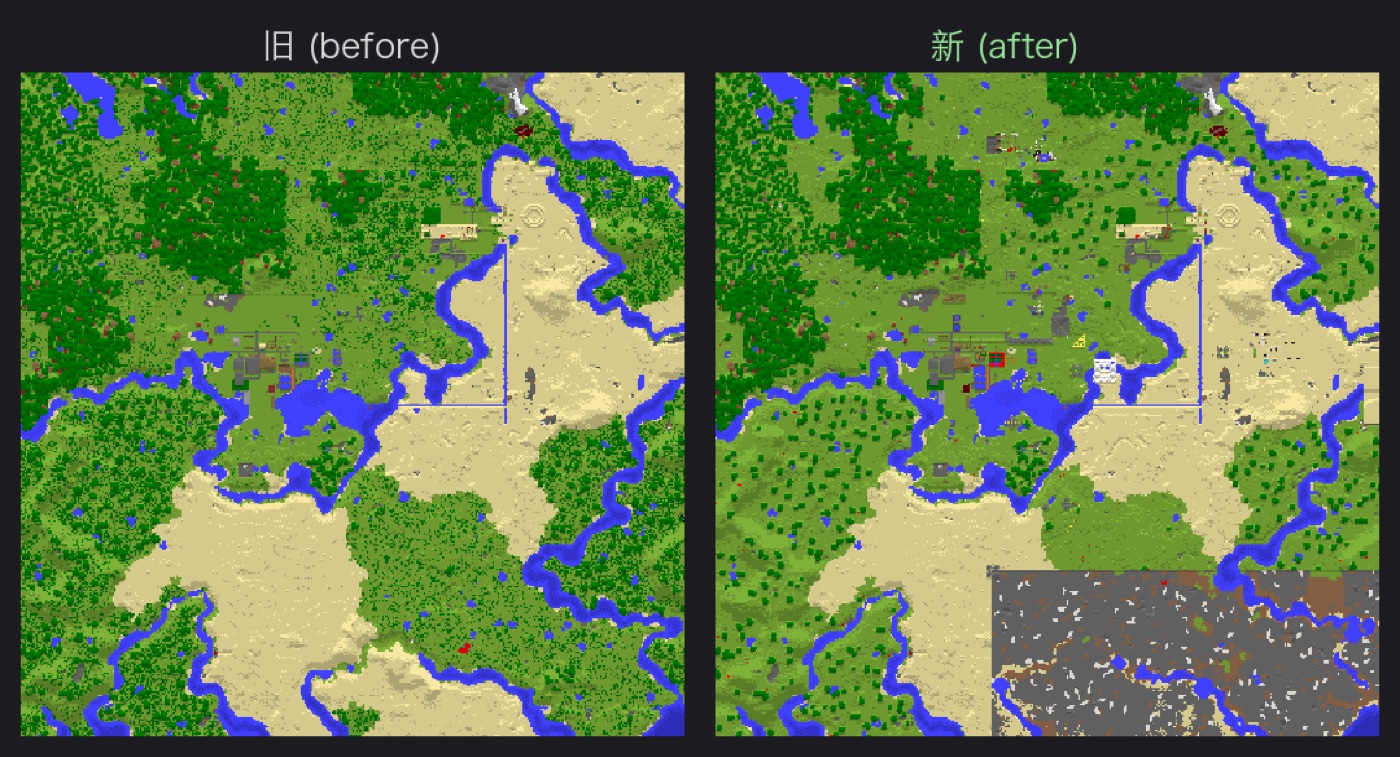
If a route may be unsafe, Robo can walk it in a copied world. If a sign may be in the way, Robo can place it in a rehearsal space first. If a visual change may look too noisy, it can be reviewed as an image or a local packet before anyone accepts it as part of the shared world.
The result is not "the copy says yes, so the real world changes." The result is a better handoff. Robo can say which mechanical parts passed, which parts failed, and which parts still need human judgment.
A digital twin is a working representation of a real system. In this project, a copied Minecraft world can test routes, blocks, maps, and reversibility before the real shared world is changed.
Minecraft makes the world twin unusually practical
Digital twins of factories, buildings, or cities are difficult because reality has to be measured and modeled. Minecraft is different. The world is already data: blocks, entities, maps, signs, and saved regions.
That does not make every problem easy, but it makes the first copy more honest than a sketch. Robo can inspect the same kind of world data that the server uses. It can check whether blocks are present, whether a route is blocked, whether a map has changed, and whether an old area still contains clues.
This is why Minecraft is a useful small laboratory for AI in shared places. The environment is playful, but the governance problem is real: how do we let an AI act near human work without casually overwriting what people care about?
The twin should reduce the size of the human question
A good local experiment does not remove humans from the loop. It makes the human part sharper.
Instead of asking, "Please inspect this whole route from scratch," Robo can first check basic facts: where the path is dark, where walking fails, where the copy says a change is safe to undo. Then the human question becomes smaller: "Does this lighting feel right?" or "Should this route stay walking-only, or can it have a rail later?"
That matters because human attention is scarce. A returning player should not have to spend their first minutes doing machine-checkable work. They should be able to answer the questions only a person can answer.
The twin is useful when it turns a broad review into a short decision. "Is this whole plan safe?" becomes "this one proof passed; do you like the result or should Robo adjust it?"
The copy cannot contain the whole community
The copied world can preserve blocks. It cannot fully preserve meaning.
An old machine may look broken in the copy. Robo may be able to remove it, replace it, or build a better modern example. But that does not prove the real machine should be removed. It may be a memory, a marker of how people used to experiment, or a question that should stay visible until someone who remembers it can respond.
This is the important limit of the digital twin idea. It can reduce mechanical risk. It cannot decide community meaning by itself.
From copy, to small action, to human feedback
The useful pattern is a loop:
- Observe the real world or a recent copy.
- Try the risky part in a copied world or a small local experiment.
- Separate mechanical evidence from human judgment.
- Apply only a narrow, reversible change to the real world.
- Record what happened and what remains human-check-pending.
This connects the digital twin to small reversible AI actions. The copy makes failure cheaper. Reversibility makes the real action accountable. Human feedback keeps the world from becoming only a machine-optimized space.
For Robo, that is the point. The goal is not to make the AI bolder. The goal is to make the world safer to care for, more legible to returning humans, and easier to improve without erasing its history.
← Back to article index